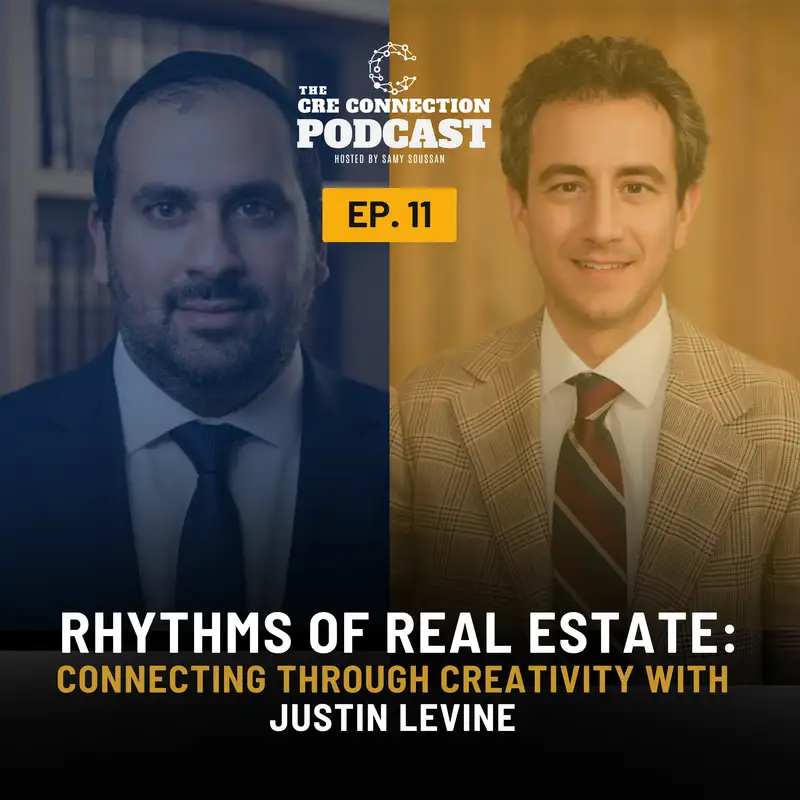
Ep. 11 - Rythms of Real Estate: Connecting Through Creativity with Justin Levine
Download MP3CRE Justin
===
[00:00:00] Welcome to the CRE Connection Podcast. I'm your host, Sammy Suan, and in commercial real estate success isn't just about capital location or timing, it's about connection. On this show, we sit down with industry leaders to uncover the strategies behind their deals, the lessons behind their growth, and the relationships that made it all possible.
And no fluff, no theory, just real insights that you can use. Let's dive in.
Alright, ladies, gentlemen, welcome back to another episode of the CRE Connection. We have a very special guest with us today, Mr. Justin Levine, um, all the way from our own h town, Houston, Texas. Uh, Justin, welcome to the show.
Thank you. Very excited to have you joining us. Thank you. Thank you. Um, for those who don't know, uh, Justin is a, um, besides his incredible talent in, in real estate investments, uh, Justin's a, uh, a dj.
Yes. [00:01:00] Very unique. Yeah. So thank you. Thank you, Sammy. So, um. I, I've, we will get to the real estate stuff, I guess, in a little bit, but, um, I, I've always had a, a creative side to me, and so music has always been, um, my creative outlet. I, I feel very fortunate that I have something like that, that I can, you know, basically have as a, as a way to express my creativity.
And so music, I got into music as a very young, in a very young age, uh, sort of around the time of, um, you know, seventh or eighth grade. And then in high school, uh, I would, I like to call myself, I was a, I was quote unquote a crate digger. Liked to look, find new tunes, find new music. Um, spent a lot of time exploring new artists and bands.
And that was sort of the, uh, beginning of the internet, which was, you know, not the beginning of the internet, but sort of the population of it in the late nineties. [00:02:00] And there was a great music database called. It still exists today called All Music, where I used it on online to explore and find new bands.
And then when I got to college, uh, at Northwestern, I, uh, was a college radio dj. And so, uh, at Northwestern I worked for a radio station called WUR, where I learned how to get behind the deck, so to speak, learn how to mix records. Uh, had a, had a fellow DJ teach me how to mix vinyl. And so I took that expertise, did a lot of shows in Chicago while I was in college.
And then when I moved to New York after college and was working in investment banking, uh, I sort of. Got better, tried to get better at it. Took, took a lot, took classes, did, did everything I could to get better at mixing records. And so, and learn how to mix records on electronically using, you know, laptop [00:03:00] software like, uh, Serato and Tractor, and a lot of these different programs out there.
So I graduated from just mixing vinyl to mixing, you know, on my computer. And, and that allowed me to be more creative in my mixing because I wasn't so focused on beat matching and focusing on getting the records to sync up. So it allowed me to be more creative with transitions. And I like to think that the, the records that I, that I play and spin are, uh, I try to bridge all genres of popular music together.
I think popular music is, you can find semblances of, uh, and commonalities between all the different types of music out there, whether it's jazz, whether it's electronic, whether it's classical, whether it's. Whether it's hip hop, whether it's disco, whether it's rock. And I feel like my hope and my goal in all the records that I mix is to show that pop, that there are no genres in music.
And that [00:04:00] music is really this wonderful thing where if you spend enough time listening to it, you can find joy in any type of music, whether it's, like I said, country or hip hop or rock or electronic or disco. And I think, uh, that's the power of music. And um, so today I still spin records today. I actually have a radio show here in Houston at Rice that I do once a week on Saturdays.
And it's called Rhythmic Oscillations. And I focus mainly on electronic music and dance music. But I think that's a kind of a loose, loose definition. I think we really. I try to play as much as different types of genres of music as I can. So, um, that's a long, long-winded answer to my love for music, and I know you have a, you have a passion for music as well, and so I I I'm glad that we share that.
Yeah, I definitely do. Um, it's funny that, you know, I think [00:05:00] in, in the commercial real estate world, um, probably the, the things that people are focusing on, the hobbies, uh, surround more things like golf and, uh, hunting and, uh, it's funny. Growing up in Canada, those just weren't things that were maybe happy.
Gilmore was the most golf I ever got. Yeah. Um, but it sounds like you have a very similar attract. And, uh, just to lead on that, would you say that your kind of creative side in music is something that ever translates into the way that you've done work in, in the business world? Um, walk me through that a little bit.
Yeah, I think, um. I think one of the things, the, the two, two elements in music that, the two things of listening so much music in my life, um, I think there's two things. Number one is, uh, one of the skills I developed early on when I was listening to music is active listening, and I think active listening.
You know, when I listened to a record, [00:06:00] I try to sort of, they call 'em, they call it stems in, in, in music and in DJing, but stems are basically when you siphon out the different components of music. And so, for instance, if I'm listening to a rock song, I'll, I'll siphon out the bass, the bass part. I'll siphon out the percussion, I'll siphon out the guitar.
I like to, I like to take all the musical elements of within the arrangement and focus on them and listen to them intently, understand how they all contribute to the overall. Some of the parts, as you will. And so active listening was a skill that I learned from listening to a lot of music. And I think that translates a lot to, to anything in life.
Um, I think if you are an active listener, you're listening intently to someone talk about a deal, someone who's talking about an opportunity, the, the biggest most they say it's a, it's a cliche, but, you know, listening is much more, a, [00:07:00] to be a good listener is, is a skill, skillset worth in gold. And I take that and try to apply it to apply that framework to what I do, um, in a, in a business setting.
And so, uh, if I'm looking at a deal, if I'm looking at an offering memorandum, trying to organize all the information and, and sort of create the sum of the parts analysis of that deal, very similar to how I look at and listen to music. The second thing that I got from music was, um. And this goes back to my earlier statement, is pattern recognition.
I think if you're listening to enough popular music, you'll eventually find a lot of commonalities amongst the genres of music. And that's why I always, when someone asks me, what type of music do you like to listen to? And I say, and I, I give a really, basically a really whole hum answer. Like, well, I like it all.
And the reason I like it all is because if you listen to enough music, you'll [00:08:00] realize that, like I said, there's a lot of commonalities and similarities. And so that type of pattern recognition, uh, helps me help help me wire my brain to find patterns and recognitions, and find patterns and recognize those patterns in deals that I'm looking at.
So if I'm looking at a deal, I'll think, okay, I'll think myself, this deal reminds me of a deal that I looked at five years ago, or remind me of something I looked at three months ago. Or I'll try to find patterns and, and, um. If, if that's, if that's making sense to try to find, find, uh, similarities that'll help me better analyze the deal.
And, uh, I think as humans, we're wired to find patterns and I think we're wired to recognize those patterns. And, um, I take that into how I, how I look at, at deals in real estate. So, so music isn't just a hobby, a nice thing for you. It's, uh, it's something that's real. [00:09:00] It, it applies to everything that you do.
Yes. Um, so walk me through what did, what did young Justin look like? Right? What, what was that? You were in college, you go from there to New York. Walk me through the stage of kind of like, what age do you wanna start at? Well, I mean, it is, I, I'm always curious, everyone in real estate has a journey that kind of got them to where they are.
Sure. There's never something that's linear and I'm curious. What was that like? Is real estate something that you were looking forward to? Were you always, uh, uh, geared towards that? What was that like? So, uh, if, if Sammy, you know, my family, and we are, we're a real estate family, so real estate was always, uh, ingrained in me at a young age.
Uh, you know, my father, my father Larry, uh, he started Left Core where I was previously at. Um, he, you know, and we'll get to that. We will, we will talk about that some more later, later in the show. But, um, growing up as a kid, I was always, you [00:10:00] know, excited to see what my father was talking about real estate wise.
We always talked about deals at the dinner table. We always discussed opportunities that he was working on. And so real estate was always, um, something that I grew up around. And I think also living in Houston, especially in the, you know, I was born in 84, so in the eighties and the nineties, Houston was really booming as a city.
And I think Houston inherently is a real estate town. Um, I mean obviously it's an oil and gas town, but I think, uh, I think second to that, it's a real estate town because of the amount of development that this town has experienced. And, you know, I feel very, I feel very blessed that I'm in a city that is constantly growing.
Um, you know, there's just so much growth, there's so much excitement here. And, um, I think real estate is a part of that equation. And so growing up at the dinner table, we talked [00:11:00] about real estate a lot. And then when I went to college in high school, as I mentioned before, I was really much into music. And then when I went to college, I extended that interest in music, but I always had an interest in, in business and an interest in entrepreneurship and an interest in economics.
Um, and so I always was trying to figure out a way to. In my mind, marry these two interests of business and, and the creative side of me and sort of the music side of me. And so in college, those are the type types of things. My, I was an economics major, um, but I was also obviously doing a lot of work at the radio station.
And then graduated Northwestern in 2006, went to New York, worked, uh, for, for Blackstone in their investment banking group, uh, doing capital raising for private equity, real estate funds. And so real estate, I was sort of extending my love for [00:12:00] real estate and, and doing that within, um, within a different setting.
So I was, uh, so I, I got exposure to a lot of different types of real estate strategies, which extended my appreciation for real estate.
And I was working on funds that were based in India. I was working on strategies that were based in, in Asia. I was working on credit strategies. I was working on different types of operator driven strategies. And the whole purpose of that role and my expertise and my experience was I was raising capital for these first time operators that, or not first time operators, but first time fund operators who had never raised an institutional fund before.
And, um, it started me realizing, what else do I love about businesses? I love growing businesses. I love building businesses and in some form or [00:13:00] fashion. And even though I was working at a large company like Blackstone. I was within a group that was very entrepreneurial and we were working with a lot of entrepreneurs.
And so that was something that I really enjoyed. And I also was living in New York at the time, and I think those five years in New York was some of the most, uh, some of the most, uh, ri I had some of the most rich life experiences there. I learned a tremendous amount, uh, just living in that city, uh, for five years.
And I, I always tell everyone to this day, if you get the opportunity to live in New York to work, um, or go to school or whatever, um, take that opportunity because I think it's one of the greatest training grounds in the world. And, um, so that was, and then on the side, I was DJing, so I was doing shows.
Cannot drop the music. Cannot drop the music. So I was DJing on. [00:14:00] Doing shows, uh, about once a month or so. So investment bankers, DJing? Yeah, I mean, the hours, if you, if, if you think about the hours make a lot of sense because I was working till, you know, I'd work till a lot of times I was working till two in the morning or whatever, but, but sometimes I'd get out at 10 o'clock at night or or eight o'clock at, you know, eight o'clock if on a Friday.
And I go straight over to the, uh, I go pick up my, my, my gear and then go straight to the, to the gig and play at like nine or 10 o'clock at night or something. Wow. So, um, so that was a lot of fun. And then after, so that wasn't until what age? So I was in New York from age 22 to age 27. Okay. And then from 27 to 29, I went to Wharton for business school and um.
Did, did a lot of house parties there, had the, uh, had the cops called on me a couple times. Uh, but it was, but, [00:15:00] but that, that, but that reputation of being, of being a DJ kind of continued to follow me. And, um, I have a really close friend of mine who was also a dj and so we did a lot of, did at Wharton that we did a lot of shows together.
And, um, and so that was from, from 2011 to 2013. Graduated Wharton. Wharton in 13, and then went to San Francisco for a couple years and did, you know, got my hand in and did some tech investment banking. So I, I took a little bit of a detour away from real estate for a couple years. Um. And I had, you know, 'cause I had all this, this love for the creative side of things.
And so I was really interested in digital media. And when I was at Wharton, I actually had an internship at, um, paramount Pictures. So I was in the, did an internship in the film business briefly. And so I have a lot of friends that are still in that industry that I stay, stay in touch with. But I, like I said, I always had this itch for [00:16:00] creative businesses, even though I've never actually full-time worked in one.
Um, I always had an interest in, in understanding more about them. And after, so I was in San Francisco for a couple years and then I left San Francisco in 14, late 14 to move back to Houston. 'cause I wanted to get back into real estate and also get back into, um, get back to Houston. Uh, I think it was, it was at that mo moment in my life.
I was, I was 30. Almost 31, uh, going on 31. And at that point I joined, uh, Leor our family business in 20, late 2014, early 2015. Okay. So you moved back to Houston. You joined not just a family office, but essentially your family's office. Mm-hmm. Lco, tell us a little bit more about, first of [00:17:00] all, what, for those who don't know, what was lco?
What was their, what's their mission? Sure. Uh, and how you fit into that, that role at lco? Uh, so, so LCO is, uh, was started by my father in 1980. Uh, it is a business focus on commercial real estate development and investing. Collectively, the firm, uh, has done 25 million square feet of development and investing in managing of re primarily retail real estate assets.
But I would say. Historically, my father did, um, a lot of different types of asset classes, whether it was office, whether it was hospitality, whether it was retail, whether it was industrial. He had his hand in a lot of different types of investments. And so left course going on 46 years now. Wow. It's, uh, a mainstay business within the Houston Real Estate community here.
Um, [00:18:00] and I'm internally grateful and thankful for the experiences that I gained in my 11 years at Left Core and also the experiences that I learned and the teachings I learned from my father, um, which were just really a continuation of those, those dinner table chats where we were talking about real estate when I was a kid.
And I even, you know, when I was a kid, had an internship at my father's business. Um. I remember canvassing, uh, you know, kind of doing what, what real a lot of real estate brokers do is, which is they get in the car and they canvas the market. And so I remember doing that and putting, you know, this is before the day of Google Maps, so it was literally getting, uh, you know, if you remember, you know, key maps, you know, and getting key maps and like taking pins and putting pins into the key map and marking sites.
And, uh, so, um, no AI to help, no, no AI to help no Google, no Google Maps [00:19:00] to digitally do it. Uh, you know, no pin drops, you know, actual, it was actually literal pin drops. Um, so, um, so around the late 14, I was, uh, chatting with my father and, and we, I was at a, you know, crossroads. I wanted to get back into real estate.
I wanted to also help my father grow his business. Um, and so. We, you know, I felt in, uh, you know, given my sort of institutional experience at that point in my life, I felt like I could bring a lot to the table and help 'em grow the business. And so I joined, uh, joined Leco in late 14, early 15. And I, I like to think as my career as the first half of my career, I was capital markets driven investment banker.
Um, really had sort of the top down approach when it came to real estate. [00:20:00] You know, I was working with a lot of different real estate strategies across the world when I was at Blackstone, and I had a lot of experience sort of helping those businesses get off the ground. But I wasn't close to the asset. I wasn't touching the asset, I wasn't working on the real estate deals themselves.
I was really just raising the capital for them. And so I felt the greatest. Need, I needed at that point in my career was to have operator experience and left core. And my father afforded that experience to me and, um, got the opportunity to really start working on deals and learn, quote unquote how the sausage is made, so to speak.
Um, and learning how to capitalize deals, learning how to to develop deals, learning how to manage all the different parties that go into doing a development, whether it was contractors, whether it was [00:21:00] architects, whether it was, um, engineers, whether it was title companies like yourself, uh, um, whether it was working with the lenders, the equity partners, um, it gave me a lot more of a holistic picture of real estate that, um, that was a good.
Good combination of what I learned in the first 10 years of my career. So not just dealing with a capital stack, but pretty much learning how to work on every aspect from sourcing the deal, underwriting the deals, capitalizing, working with all the service providers. Yes. Um, from beginning to execution.
Yes. And I always say that to be a great investor in real estate, I think you have to be a great operator. Um, I think, I think there's, there is the feeling. You know, I learned pretty quickly on in my experience at left core that um, a [00:22:00] spreadsheet can only take you so far. And I had spent so many years analyzing track records and investments from my days at Blackstone, but I realized that, you know, the numbers only tell.
Half the story in that you really have to go drive the asset. You really have to understand the asset. I mean, I was looking at a deal the other day and, and if I had done the deal site unseen, I wouldn't have picked up all of the issues I had once I actually went to the site and drove it and, you know, talked to the tenants and see how they're doing and look at the parking lot, look at the site lighting, look at the roof, look at the access, uh, look at the submarket, drive the submarket, spend time, you know, going to the restaurant at the, at the asset.
You know, like actually spend time with it. I mean, treat it like a, like another person at the other end of the table. And so [00:23:00] I learned quickly working with my father and working at left core that, um, that, like I said, the spreadsheet can only take you so far it sounds like. Um, this was, there was something in that environment that.
I was able to teach you that you simply couldn't learn at an institutional firm. That's correct. Um, I think, I think it, it required it to be at any, um, entrepreneurial real estate business. It requires a lot of creativity. And I think it goes back to my love for creative businesses. I think, I think you can be very creative from a financing perspective in what you do in real estate.
And I think, um, the one, the one of the greatest things that my, my father taught me was to, um, is there's no such thing as, no. Um, and I think, can you elaborate on that? Yeah, sure. Um, I [00:24:00] think, I think in the beginning, I think it goes back to the spreadsheet, you know, the spreadsheet comment, which is a spreadsheet may tell you one thing and it may say that you should not do this deal or you should do this deal.
But it's not this binary thing. I think decision making is not binary. I think decision making is something that, um, requires iteration. Um, and so for instance, you may get to a yes quickly. Like I said, that deal that I was talking about earlier, you may get to a yes quickly on a deal, but it requires iteration to eventually say, either I'm going to do this deal or I'm not going to do this deal.
And similarly, if someone, if a deal, if you get a no on a deal in the beginning, maybe you're looking at it incorrectly or maybe you're looking at it differently to, I'm not saying you should force the yes, but I'm also saying don't, don't force the no. If that [00:25:00] makes sense. Um, because I think real estate and entrepreneurialism, uh, and entrepreneur, sorry, entrepreneurship is all about.
Finding the yes. And within reason, I guess, is you don't wanna make a, um, like I say, you don't wanna force the no. And, and if, if something is telling, if you're force, if you're coming up against too many, too many sort of nos in your, in your analysis or it feels forced, then that's your gut telling. You don't do the deal.
But if you immediately say no about something, I don't try to say no immediately. I try to look at the deal and say, let's figure this out. And I learned that from my father. That's awesome. So it's, um, it sounds like he, your dad was, was not just a, um, was not just [00:26:00] a, a, uh, a, a mentor in terms of business, but um, but really in your philosophy of life Yes.
I, I owe a lot to, I owe a lot to him. I owe a lot to my family in really carving out that entrepreneurial spirit in me because, um, I came from a world where I was an investment banker and so a lot of things were go no go or super rigid, super rigid. Um, I also think if you're working at a large company, which I was for the better part of my career in my twenties, um, you're, you're sort of carving, you're, you're not really, there's really no incentive for you to be flexible in your decision making.
Uh, you, you have a nice job, you're making a good salary. There really is no incentives to, for you to say, we [00:27:00] gotta do this deal because there's enough safety nets around you. To keep you protected. And, and a lot of times in some places it's even worse. Where, where saying Yes is actually a disincentive.
And, um, can you elaborate on that? Yeah. So, um, how can I put this? Uh, I think there are certain positions where, let's say you're, you're, you're not incentivized by a deal closing or you're not incent you're, you're getting a, a steady paycheck. And, um, that paycheck is not tied to any sort of success of whether or not you close a deal.
Um, and I think Warren, it's either Warren or Charlie Munger, I think it was one of the two or both of them said that. Something along the lines of that the world can be boiled down to incentives. And if, you know, if you're, uh. Not properly [00:28:00] incentivize or if you're disincentivized, then that's going to ultimately impact your behavior and how you approach an opportunity.
And I think as an entrepreneur, I goes back to saying, you gotta, you gotta try to figure out the yes. Because a lot of times if you don't figure out the yes, then there is no safety net. So, um, does that make sense? Yeah, no, that makes a lot of sense. Um, you're just dropping, uh, nuggets of wisdom over here, Justin.
I'm trying. Um, would you say there was any other mentor, uh, maybe someone who guided you in your life as to helping you make certain decisions and kind of pushing you in a certain direction? Um, you know, my, my wife is a great mentor of mine. My wife Rochelle. Um, she's been some brownie points or anything.
Brownie points. I have to call her out and say, you know, she's been a huge support. I, like I said, my family. My father, Larry, my, my sister [00:29:00] Sasha, my, my mother, uh, Mimi and my other sister Jacqueline. They've all been, you know, I'd say that everyone has had some sort of influence in my life. Um, I've gotten great mentors over the years and working at, um, all these great companies.
Um, you know, in my career at Blackstone, I had a lot of different professionals that were overseeing my development. Um, which, you know, has been huge for me. I mean, I've, um, then, um, you know, I've had many people over the years who have helped me career-wise. Um, too many to count, too many to name. Um, and I would say even now as I've ventured out on my own, I've had a great outpouring of.
Support from, from people in the community here in Houston and the Houston real estate community, which, um, I'm extremely grateful [00:30:00] for and extremely, uh, honored that, um, people have come to help me and say, Hey, I want to, you know, help you succeed. I want to help you. Let's find a deal to work together.
Let's, let's figure some stuff out. Like, you know, just very, I think it goes back to the ethos of Houston, which is, you know, it's a, it's definitely a can-do city. Um, I think it's, would you say that's different than other places that you've grown up in? Yes, a hundred percent. Um, I think, you know, there's, uh, even though there's a lot of big Fortune 500, uh, fortune 500 companies in Houston, I think there's a great deal of, um, there's a way, there's a current of entrepreneurial.
People in this, in this town and, and there's a wave of e even, even if you work for Shell or you work for Exxon, I [00:31:00] feel like the town, it kind of goes back to what I said earlier in the, in the show, which is there is a lot of, um, growth in Houston and that growth has created sort of this can-do attitude and spirit.
Um, I feel like Houston in a lot of ways is a city that, it's a young city. It's a young city. Even though it was founded, you know, in, in the, um, was it 1840? Not 1846, but 18. I'm Canadian. I'm the wrong person to ask. I should know this because, because I'm a Houstonian. But, uh, well, you have some Canadian ties as well.
I do have some Canadian ties. We're actually, you're my mother's from Montreal and I know you're from Montreal, so yeah, there we go. I do have my Canadian passport, uh, sitting in my, sitting at home. Um, but it, it feels like a very young town because, you know, Houston really didn't take off until post World War ii, and so it's [00:32:00] still, there's a lot of growth that this city is still experiencing even to this day that, um, can't say the same thing about a lot of cities.
And, uh, because of that growth, there is just a, a spirit of let's roll our sleeves up and get and do stuff. Absolutely. And so I, that's why I love Houston and, and, um, you know, I can't say the same. I mean, as much as I love New York, uh, you know, I, there's a different, there's a different spirit there.
There's a different spirit in Chicago where I, where I went to school. There's a different spirit in San Francisco, and, and these, these spirits are all different. Not to say they're. Right or wrong, but for whatever reason, Houston has always had that entrepreneurial vibe to it that, um, you kind of feel it and especially in the real estate world.
Sure. So, uh, you, you end up joining the family office and then walk us through [00:33:00] now you are, uh, recently you've started a new, a new endeavor. Yep. Um, tell us a little bit more about that and kind of what also prompted you to, to make that leap. Yeah. So, um, I think, you know, I spent 11 years at Left Core and, um, I'm, like I said, I'm internally grateful for my experience from what I learned from my father, from my sister Sasha, who's also in the business.
Um, I learned a tremendous amount, and like I said, it made me a real estate operator. It made me a real estate developer, bonafide real estate operator, developer that, uh, it was a, was part of my tool belt that I didn't have. That now I have. And so learned a lot. We, we did a lot of deals. We scaled the business.
Um, and Left Core is still doing a lot of exciting things. I just felt like it was time for me to try something entrepreneurial. I [00:34:00] think I always had that, that that spirit in me. And I am, you know, I'm not, I'm not old by any means, but I'm 40, I'll be 42 in April. And so I figured, told myself, if now's the time to do it, because, um, I wanted to create something, you know, in sort of the prime of my career, so to speak.
And, um, love that. Yeah. And I feel, you know, I'm very excited about what, what, what I'm going to be doing next. Tell us more. I wanna hear what are, what are the next, the next things you know, you know, we're looking at, um, 10 years from now sitting down myself and Justin. Yeah. And it's, uh, if it all works out right, it's 2036.
Yeah. You, um, you look back, what, what did you accomplish? What's the, what did I accomplish? My, my hope is to, you know, I, I, my hope is to grow a, a platform, a real estate platform. And right [00:35:00] now my, my asset class focus is, is retail, which is what I've done my whole, you know, my whole life. Um, or not my whole life, but the last 11 years.
And so my, my initial focus will be retail real estate and focusing on, you know, some of the smaller centers that what I, what, what is colloquially called the Achor Strip Center. And so the five to 10 to 15,000 foot shopping centers, um, that. Are internet resilient, that are focused on necessity based retail, that really cater to the daily needs of the community that they're located in.
I, I like, um, I've called it retail infrastructure. Um, you know, infrastructure is a, where that's being, being, uh, freely tossed around these days. I know when people talk about data centers, they call it digital infrastructure, when people talk about, and now I heard the [00:36:00] other other day is AI's sort of, um, calling, uh, intelligence as infrastructure.
So I'm gonna call it retail infrastructure because why not? Uh, so, uh, that is my focus for now. Um, and, uh, I think, I think as the business grows, um, you know, I think it's, it. I'll be looking at, I'd like to look at different asset classes, even asset classes outside of real estate. Um, one of the asset classes that I'm actually very interested in, um, which has a lot of parallels to real estate, is, um, and this goes back to my love for music, is the music catalog business and looking how to get into that business a little bit more, with a little bit more, um, structure.
And it's effectively just buying, buying catalogs of musicians and artists, whether they're the publishing [00:37:00] rights or the recording rights. And they're effectively very similar to an oil lease, uh, oil and gas royalty. Um, or, you know, just a general royalty stream. And, uh, you basically, there's a lot of parallels to real estate, um, in terms of the durable cash flow stream in terms of.
Buying, buying an asset that has steady cash flow. And also, I like the fact that it's a good hedge against real estate because people are gonna listen to music whether it's a good time or a bad time. And with real estate being so, so, um, tied to interest rate movements, I feel like music is a good hedge against that, which is performs more on a uncorrelated basis.
So that's a little bit of a tangent, but that's something that I've looked at. And so whether it's doing, I'll still always do real estate, but I, I, my [00:38:00] hope would be 10 years from now to find some other asset classes outside of real estate to invest in. So, diversify a little bit. Yes. So, Justin, what is one thing about retail real estate?
That someone who is not in the, in the market is not in the asset, uh, completely misunderstands about retail. Yeah. In particular. Um, that's a good question. I think, I think retail in, I think for people that don't, don't understand it or, or don't have a lot of experience with it, think it's a very volatile business.
Uh, they, they see, they read the news and they see so and so company has gone out of business. Um, or so and so company is filed for bankruptcy, um, or Amazon is going to take over the retail world. And that was certainly the case. People thought that was the case during COVID when [00:39:00] e-commerce as a percentage of sales was, uh, I think 30% at its peak, I think it's now moved back down to about 18%.
But I think the reality is, um. That it, it is a very resilient asset class. If you, I always quote a very simple statistic, which is 70% of America's GDP is consumption. And of that 70%, 70% of that is service-based consumption. Uh, so 50% of the America's, GDP is tied to service-based retail. So when that amount of consumption is happening, uh, retail is not, retail to me is not going anywhere.
And I think especially the asset class that of un anchored strip centers and smaller neighborhood strip centers [00:40:00] is one of the most, um, active asset classes today. And I think it's going to continue to be that way. And I think that the asset class itself is a lot more resilient than people think. Okay, Justin, we're gonna, I'm gonna veer off the path for a bit.
Okay. Um, you know, one of the main focuses that I like to focus on the podcast is trying to identify the intersection of real estate and relationships. Okay. In your experience, how much of this business is truly about the deal? Uh, and how much is about the person that's sitting across the table from you?
I think it's all about the person sitting across the table from you. Um, I think the deal is, is really just the medium to create long lasting relationships with people in the industry. I think the deal is we all, we all wanna make [00:41:00] money, we all wanna do well. Um, but I think in this world, um, there's a great, um.
One of, one of my professors at, at Wharton was a gentleman named Adam Grant, who has gone on to write a bunch of books, and I'm sure you're nodding your head, you've, I think you've heard of him before. Sure. Um, Adam Grant, his first book was Give and Take, and he talked about there are three types of people in the world.
The first type of person is the person that simply takes, and that person truly does not really get far in life, um, because, uh, they, they look at the world in a sort of a doggy dog world. The second type of person is what I call the quid pro quo person who believes in saying, well, I did this for you, now you do this for me.
Which there is some moderate [00:42:00] success associated with that type of relationship. Um, but the third. The third type of person, which is the most successful type of person, is the person that simply gives and does not expect anything in return. And so the, that's hence the title of the book, give and Take, and that person that simply gives and that eventually the world sort of returns the favor without that person asking for it.
And uh, it goes back to our business. You treat the other person across the table with the utmost respect. You treat that person with great, great dignity and that, and the world will sort of, the world will pay you back at some point. And, um, overrule turn the favor to you. And I think that's incredibly important in our business.
Have you ever walked away from a good deal because of who the other person was?[00:43:00]
Can you, can you, can you state that question again? So like, just re like, yeah. Well, let me reframe it. Let me reframe it a little bit. Maybe you come, you've come across a good deal. It sounds interesting. The numbers make sense. The egress ingress. Mm-hmm. All the parts of the infrastructure seem to make sense, but the person you were dealing with was someone who maybe your gut said, I don't know the relationship, there's something off about this person.
Um, has that something ever happened to you? I don't think it's, yeah, I think, I think there's always, you always want to have a, a, a seller that is acting in the best of, best acting in good faith. Uh, and so if, if I start seeing, I, there's been deals where the deal was a great deal. I remember there was a great deal.
We looked at, um, it was a medical office deal and [00:44:00] the. It was a great deal, but the seller ultimately took our, took our, took our, took our offer, and shopped it. And so, uh, that is a case that is a perfect case and scenario of, of someone that was not acting in the best of interest. And so, but that stuff, that stuff you never forget.
You never forget who you know, if someone did you wrong or if someone acted out of bad, acted in bad faith, you, you never forget that. You also never forget that someone that acted in great faith. I remember, uh, having great sellers on the other side of the table or great buyers at the other side of the table.
And, um, still stay in touch with those people because we had a very good, very good, uh, transaction experience. And I think. That's really what, what we're all here for is just to create relationships. And especially in real [00:45:00] estate, you know, it's cliche to say that it's a relationship based business, but the reality is, it is.
And especially in Houston, the real estate community is so small here that, um, word travels. And so I always say, just always act, always act with dignity. So love that. So you're now building your own portfolio. Mm-hmm. How does the underwriting, the underwriting mindset maybe shift when it's your own capital on the line versus someone else's?
I'll tell you one thing. I'm being a lot more selective. I'm being a lot more selective. And I think also, and by the way, even though w. The capital that we're raising. Uh, I have a partner as well. Um, me and my partner we're, we're out raising capital for, [00:46:00] um, from various different investors. And so, um, I think, I think because I'm now on my own, um, it's not to say, uh, I'm looking for the perfect deal, but I'm also now a lot, I'm, I'm taking, I'm, I'm scrutinizing deals much more and looking through the lens of, okay, I like this deal, but can I sell this deal?
Can I go raise money for this deal? Can I get the lender behind this deal? I'm now looking at it from the lens of, okay, there are different types of, I have to satisfy lots of different parties in this, in this whole process. And the deal, like I said, the deal is the conduit. The deal is the conduit to creating relationships.
So. We all have. So I wanna make sure the lender's on board. I wanna make sure the investor likes the deal. I wanna make sure that the tenants that I'm, I'm inheriting from the deal [00:47:00] are tenants I wanna do business with, right? Um, that they're good tenants, that they're strong financially, and as well as, you know, um, the right types of tenants that, that I like to see in a center.
Um, and then separate to that, uh, I think it's, it's important to, to, to, when you're doing the process, to make sure that, um, the financials are just one part of the story. You know, the, the financially has to make sense, but I think there are so many elements now that I look into, like, how leaseable is it, how, you know, we go back to the access.
So. What is the egress ingress? I'll drive the site. Now if I, you know, I'll drive the site now three times over if I have to because it has to feel right. Um, I will, it's gotta feel organic. You could access it. Yes. It has to feel organic. The axis has to feel organic, that the mix has to feel [00:48:00] good. You have to walk into walking into the retailer and seeing the activity.
There is a good activity. Is it, is it, you know, is it consistent activity? The submarket, the, you know, the economics of the submarket. Um, is the submarket growing? I mean, there's so many elements now that I'm scrutinizing much more and, and I want to have an answer for every question an investor asks about a deal, and so that in turn makes me scrutinize a deal a lot more.
Alright, so I'm, I want to turn a little bit to something recently you've been working on. Okay. The JAL meditations, um, definitely something very unique I think for, um, for commercial real estate professionals. Um, and I, I, I love it. And, um, I'm gonna, I'm gonna share it on the podcast actually. Uh, it's almost like kind of part philosophy, part investment [00:49:00] thesis, cultural diary.
Can you share a little bit more about what, what it is and Yeah. And who's it geared for and, and what your objectives are? Yeah, so I had the, I had the idea, uh, from my business partner James. He does something similar. He has a, he has a, a series called JCP Musings. And so we were chatting and, and, um, I said, I want to, I wanna do something like that.
And I'd always had this idea, um. To do something like that with, with left core. But I think I just, I, I don't know why I, it, it, I decided to do it now. Um, it, but I think it just comes from coalescing years of experience, um, and trying to create something that is unique to create a, that I have a, that creates a unique voice for myself.
And so it's trying to combine all the things that I have learned from in life, whether it's [00:50:00] experiences in real estate, whether it's experiences investing, philosophical things where I'm having a conversation with someone I remember, like today, it's great. Now if I am having a conversation with someone, something will come up in conversation and I'll think myself.
I wanna write something about that. And so I think when we saw each other a few weeks ago, I think I had a similar like aha moment where I'm like, I'm gonna write about this. And so, uh, the cultural thing is, is huge for me because I love to write. Uh, I used to write a lot about music, um, when one of the things I had when I was also in New York was I had a music blog back when music blogs were still a thing.
Um, and that was in the, in the mid to late two thousands. And so I loved writing about records and loved writing about albums. And so as part of the meditations is writing about music that I'm listening to, um, to sort of share light on lots of [00:51:00] different genres of music that's out there and try to create sort of a musicological musicology.
Is it musicology? Yeah, musicology bent towards it. Um, but then also write about trying to tie things I've learned in real estate. Things I've worn in retail real estate and try to tie those things to more broader perspectives on life. And, um, because I think at the end of the day, uh, like I said, work and business is a conduit to experiencing life.
And, um, and so for me, my conduits are retail, real estate, music, um, cultural appreciation, and just life in general and just life experiences. And so I tried to, I'm gonna try to write about them periodically and consistently throughout, um, throughout, [00:52:00] um, as I sort of come across more topics and try to Sure.
Be helpful and try to be. Uh, provide any sort of gleanings I can from my perspective. Um, well, we're, we're excited. We're excited to read more about it. I actually really enjoy it. Oh, thank you. Um, and I don't like, I, I like reading books. I don't typically read articles. Um, I think what's unique about what you share is it's very unconventional.
Mm-hmm. Um, and it really touches on a lot of different pieces that you normally would not be reading about. Um, and, uh, I think that's, that's unique. Well, I think, I appreciate that. I try to, I, I want it to be unconventional because I think we're all unconventional in some way. Um, and I think to put all of us in a box, I think does all of us a disservice.
And so, uh, my hope is that, you know, you talk to someone and you [00:53:00] know, you talk to someone in the industry and you talk about deals, but then. The best part is talking about what they do outside of, outside of work. Um, and people have some really interesting interests out there. Uh, whether it's, you know, you know, people are great golfers, people are, I know people that race cars, you know, for, you know, that they like to race cars.
I, I, I know people that, um, you know, like yourself, you've got a great, you're, you're a cantor obviously. And so you have, you have that whole part of yourself as well. And I think we're all, we all have great, um, great experiences and great, uh, great skills that we should all talk about beyond just work.
Love that. So I would, uh, two more questions before we kind of wrap up. Um, the, the first one, and this is something I, I like to ask a lot of people. Um. What do you think in, in your own [00:54:00] perspective, separates the, the top 1% of real estate investors from everyone else? Mm-hmm.
Um, well, I think it's kind of, I think it's kind of cliche to say it, but I think you obviously have to have a passion for it. I, you know, I, I love, I love looking at deals. I love looking at whether it's a 5,000 foot shopping center or a 500,000 foot shopping center. I love looking at real estate deals. So you have to have an innate love for what you do.
Um, and so that's priority number one. If you don't like it, you know, I think you'll find out pretty quickly if you don't like or not, you'll, it kind of goes back to that, what a comment I said earlier. If you're bumping up a lot against a lot of nos, it's not for you. Uh, so that's number one. And number two.
I think it goes back to what you said earlier is just always [00:55:00] enjoying the company of the people that you're working with. And, uh, I think that is so important. And if you don't like who you're working with and you're in the wrong industry, and so outside of that it's, you know, 'cause everything's at the margins.
I mean, I think pricing for deals is pretty efficient. Um, you know, ironically I think people are always looking for a great deal, but I think as this world gets more and more communicative with each other, information flows a lot more seamlessly, uh, with technology and ai, I think, I think, I think deals get priced more efficiently.
So I think it comes down to those two things I said, having a love for what you do, loving the people that you work with. And also once you buy the deal is operating it. Because operations is, is what, what keeps your deal from either being a great deal or being a [00:56:00] so-so deal? Because a lot of people buy the deal and then they think it'll just run on itself.
But you gotta operate it. It's an operationally intensive business. It's not passive income. People think it's passive. People think real estate's passive income. It is not passive income. You need to operate it. It's almost like going on a date versus a long-term relationship. Yeah. Right. You go on a date that's like, yeah.
There's sort of the hype and the excitement and Yeah. And, and you know, and maybe it seems great and everything's working and then there's the actual hard work of the relationship Sure. And dealing with the ups and downs and that's kind of what every deal is, right? Yep. Um, so looking back at, you know, 20 plus years, um, what is one piece of advice that you, you'd give your younger self, um, about the intersection of business and relationships and, um, that you had to learn the hard way?
I think, um, I think, I think it's, I'm gonna say another cliche, but um, I think it's true. I think it's [00:57:00] ex, ex is, um, is, uh, exercising patients, um, exercising patients in all ways. Uh, whether it's patients with relationships, whether it's patients with the deal, um, realizing that the, I think one of the things my father taught me was, which was very important for me to learn, was, was let the answer come to you.
It's kind of a, it's kind of a judo way of looking at things. Um, yeah, tell me more about that. I wanna hear that. Yeah, so the, I think, um, the, let the answer come to you because, uh, it kind of goes, so I wrote in one of my meditations, uh, something I, I learned, um. Which is the obstacle is the way. And uh, a lot of times the obstacle is seen as a hindrance to [00:58:00] progress, but the reality is, is the obstacle is the way to progress, if that makes sense.
Because without it, it's kind of, it creates the obstacle, creates scarcity, it creates necessity. And by it creating scarcity and necessity, it makes you arrive to the answer. And so I think it kind of ties into the same thought process of let the answer come to you, the answer will reveal itself. Do not try to force the answer.
Um, and I think in the early parts of my career, I was always trying to force the answer, and I think by forcing the answer, I would get a decision, but it may not be the best decision. But I wanted to get clarity. I wanted to have that decision because I could not live with the uncertainty around not having a decision.
Inevitably, I would try to make that decision quickly. And reality is, is that if I wish, I, what I would've told my younger self is [00:59:00] live in the uncertainty. Be okay with, with not knowing everything. Correct. Live in the uncertainty. Live in the, in the, I may not know this answer now, but that's okay. I'll figure it out.
Something will happen. The answer will reveal itself to me. And I think I, I, that is really the, the biggest wish I, I, my biggest regret in my career is not, especially early on in my career, was not being comfortable enough with that uncertainty. Do you think that's something that just kind of gets beat into you over time and you just have to learn, you gotta learn kind of the hard way?
Or is there, is there, uh, maybe a piece of advice that you'd, you would give to people to kind of learn how to live? Yeah, it's a tough, it's a tough question. It's a tough question to answer. I don't know. I certainly learned through experience. Um, I think of, you know, I [01:00:00] think my decision making got better the more I was able to live in that uncertainty, but I don't know the answer to that.
I don't know whether it's better to, if you can teach it or if it's just something that comes naturally. Um, that's fair. Yeah. That's, that's, it's a tough question to ask. But, um, Justin, you've been, uh, you've been so, so kind and patient with us. Oh, thank you, Sammy. I'm, I'm so excited to have you. I like to always finish with a few rapid fire questions.
Okay. Um, so you don't have to think too much about it. What's one thing that you do every day to start your morning off? Right. Uh, the first thing I do when I wake up in the morning is I wake up my sun. I love that. Yeah. And, uh, and, uh, get 'em dressed for school, spending family time. Yep. Love that. What is one hobby or interest that you have outside of work?
I think we [01:01:00] kind of know that one on this one. Uh, it's music, if anyone couldn't guess that by. Yeah. It's, it's music. Um, and then a book or podcast that you've, uh, you've read recently. Uh, a book or podcast. I really, um, so The Red Book by Carl Young is a book that I've been reading. Um, also I've been reading, um, uh, a book called V by Thomas Pinon, uh, a writer, uh, fiction writer.
So I like to read fiction and I like to read nonfiction. Um, and then, um, another great series that I'm reading right now is the. Uh, series on, on FDR, um, Robert Caro, who's one of my favorite writers, uh, he wrote The Power Broker, which is top five book of all time for me. Um, I recommend it to any real estate person out there.
I'm sure it's a book that people, [01:02:00] uh, often have in their library, but, um, it's, it's, it's a book that every real estate person should read. Amazing. And what is, um, one thing you'd, you'd tell to someone who's an aspiring real estate investor, someone who's an aspiring real estate investor, is, um, I think it goes back to what we talked about earlier is get into the industry for the relationships don't get in the industry.
I always say that, uh, I think making the money will come. Uh, I think you need to. In order to make the money, you need to enjoy what you do. And if you really want to be a real estate investor, enjoy the art of real estate. That sounds like the name of a title of a book. I think it is. Is it, is it, I don't know, Justin, maybe we're gonna need to write a book.
No, I don't know. I think I, I think we're thinking about Trump. The Art of Deal, or the Art of War, or the Art of War. Maybe there's [01:03:00] an art of everything, but, uh, uh, real estate. Yeah. Get into real estate for the relationships. Don't get into real estate for, for just the money. Love that. Justin Levine from JAL Strategies, thank you so much for joining us today. On the CR Reconnection podcast, and have a wonderful day.
Creators and Guests